Horse vaulting or equestrian vaulting is an exciting sport which everyone can enjoy. It combines dancing, gymnastics and riding into a sport which can be a spectacular to watch, and is fun to do, no matter what your level of experience.
Training for vaulting will always improve your riding, because students are required to perform exercises which improve balance, strength, suppleness and stamina as well as an ability to predict the horse's movements and move in harmony with it at all paces.
Otherwise known as gymnastics on horseback, vaulting was a popular sport in Roman times. It evolved along different paths to become circus bareback riding, roman riding, and various branches of trick riding. It was adopted by the military as an effective method for training soldiers to ride and skillfully wield weaponry at the same time. More recently it has become a highly competitive international team and individual sport. It is one of the eight FEI recognised disciplines.
Valley Farm is probably most famous for its success in this field, having trained vaulters who competed nationally and internationally for more than eight years during the 80's and 90's.
Vaulting is an excellent, fun way for all riders to improve their confidence and balance, and is especially good for developing an independent seat. It can also be a good way for non-riders to get used to horses and horse-riding. Some people liken it to an exercise class involving horses rather than gym equipment.
Vaulting can be extremely beneficial for young children, nervous riders and RDA participants, because they do not have to guide the horse, but are able to focus on themselves.
Vaulting helps with memory, musicality, numeracy, imagination, concentration, perserverance, horse sense, responsibility, independence, proprioception and social skills.
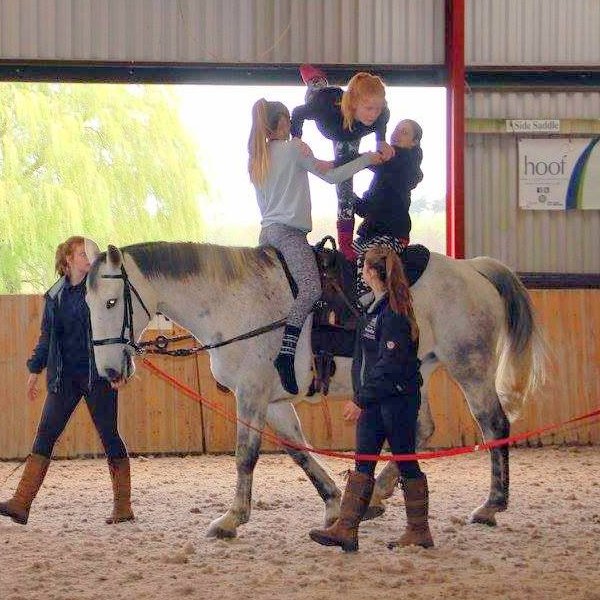
The sport involves either individuals or groups of up to three people performing specific movements on a horse. Starting off with simple moves, like sitting facing forwards, while the horse is walking, to moves in all directions including shoulder stands, forward rolls and backward flips in canter! If you have never seen it, you might describe it as bearing a resemblance to cheer leading, but on a horse rather than on the ground.
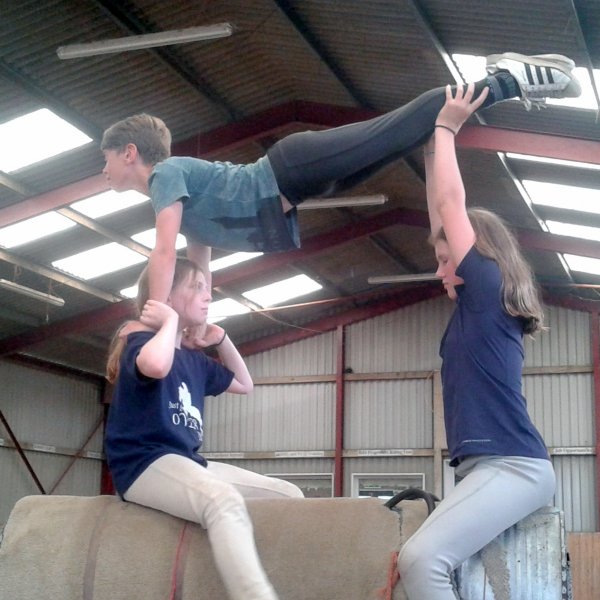
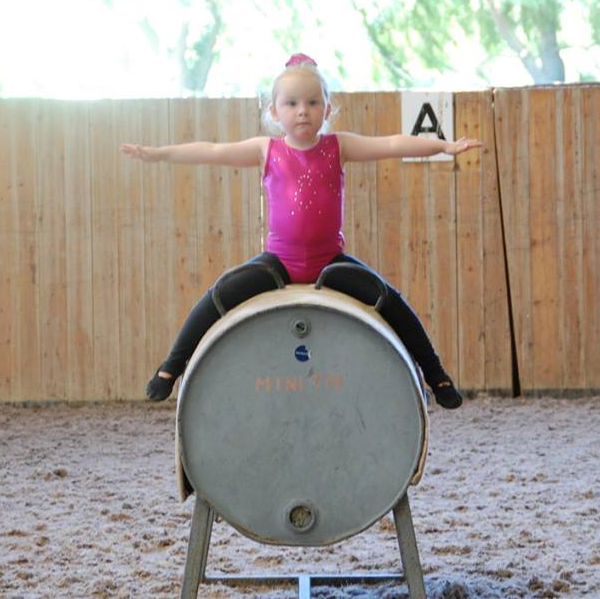
All the moves are taught on a tin/wooden horse before moving on to the real thing, and are practiced in walk before moving on to canter. You can progress at your own speed, and need only do moves you feel confident with, so don't let the antics of some professionals scare you off!
If you are interested in developing your vaulting or riding skills, or are simply looking for a fun way to keep fit then Vaulting could be for you. If you love horses, dance, gymnastics and fun then you will love vaulting. We cater for all ages and abilities including people who have never been on a horse before, riders with additional needs, adults, children, schools groups and clubs, birthday parties, bucket listers and serious vaulters who wish to improve their technique for competition or for fun. Come along and give it a try. Spectators welcome.
Our vaulting coaches are qualified with British Equestrian Vaulting and Riding for the Disabled Association.
Private or shared private one hour, or half hour lessons can be arranged for individuals or groups. Keep an eye on our social media for clinics or join one of our regular groups.
Vaulting is a popular activity during our pony days and for summer camps.
Vaulting on
Vaulting on is the term used for anytime a rider leaps from the ground to mount a horse without using stirrups or a mounting block. This could be while the horse is standing still or at speed. It is a skill required for trick riding, gymkhana games, and equestrian vaulting. It can be performed with vaulting handles, a trick saddle, a normal riding saddle or bareback. The skill is best learned on a barrel horse so as not to cause discomfort to a real horse. When performed correctly, it can be done without putting any pressure on the horse, but everybody has to start somewhere so we provide lessons to help riders develop various techniques with our tin horses before moving on to real horses of various sizes.
FAQ's
What is Equestrian Vaulting?
Vaulting, sometimes known as voltige is an international competitive sport supported by the FEI, which combines dance and gymnastics on a moving horse. The horse wears a specially adapted roller with handles and leather loops to evenly distribute weight and help the riders mount and perform moves. Under the roller is an extra large, well cushioned pad to provide grip for the vaulters, and protection for the horse's back. A normal snaffle bridle is worn with a lunge line attached to the bit. The horse is trained to respond to whip signals given by the lunger, allowing the vaulters to complete complex routines without interfering with the horse. Vaulters learn to move in time with the horses movement with smoothness, lightness and grace, so that the horse becomes a dance partner. Marks are awarded from 1 to 10 for the quality of each move.
Who is vaulting for?
Anyone can vault. There are competitive teams and individuals, but lots of people vault just for fun or to improve their riding. The handles and soft pad used for vaulting can be beneficial for helpful for people who have less mobility in their legs, allowing them to feel the enjoyment of riding while being able to hold on securely with their hands.
It is a wonderful way to develop coordination, strength, balance and creativity whilst working in harmony with the horse. Vaulters also develop self-confidence, trust, responsibility, and learn to work in a team.
We offer classes or private lessons to both children and adults and RDA. Vaulting is a popular choice for corporate groups, as at basic level on one of our exceptionally patient horses, adults who have never been near a horse in their lives have great fun learning how to kneel, sit backwards and sometimes even stand up!
We offer 'have a go' sessions for pony clubs, riding clubs, scouts, guides etc.
For the more dedicated, classes are offered from novice to advanced international standard.
Am I too old or too young?
There is no upper or lower age limit, you just need to be able to follow instructions. You only have to do moves that you feel comfortable with, so everybody in a group can progress at their own speed. We encourage parents of young children to help, and to walk next to the horse until the child feels confident. Many parents end up having a go. (but you don't have to!)
Do I need to be able to ride?
No, you don't need to know how to ride, because the horse is not controlled by you, but by an experienced lunger. Vaulting can greatly improve your riding, and in many countries children are encouraged to learn to vault before they try riding.
Do I need to be able to do gymnastics?
No, because you start off with very simple moves. You do need to be able to do a simple warm up, like you might do before you begin any sport. If you are already good at gymnastics you will be able to make faster progress when it comes to more complicated moves.
Do you offer RDA vaulting?
Yes we provide private lessons or group lessons for people with physical or emotional disabilities and additional support needs. It is a hugely rewarding activity where participants can progress at their own speed. We have coaches qualified with Riding for the Disabled.
Is Vaulting Safe?
Yes, vaulting has an excellent safety record. Studies have shown it to be one of the safest of all equestrian disciplines. Many factors contribute to the safety of this sport including the fact that the horse is controlled at all times by an experienced trained lunger, not the vaulter. Vaulting is performed in an enclosed ring with soft footing. Vaulters are taught to condition their bodies with stretching and strengthening exercises and are also taught safe mounts and dismounts at all levels. Most exercises are learned on a stationary barrel before being performed on the horse. You can learn more about safety from British Equestrian Vaulting or the American Vaulting Association. The risk of serious injury is minimal compared with riding in a car, roller blading, or riding a bike.
Why are helmets not usually worn?
Studies have shown that helmets are not necessary when vaulting, as with other forms of gymnastics. In fact wearing helmets can increase the risk of injury to the vaulters and horse if they get caught up on the handles or side reins. For more information on this read see Vaulting Safety | Equestrian Vaulting USA
We are however happy for beginners to wear protective headgear while they are learning the basics if they wish. Hats are not very safe once you progress to team work, as they could injure another vaulter, and are not practical once you move onto rolls, and shoulder stands etc, as they could get caught up on the tack. Riding hats without a peak and tagged to current safety standards are currently required for RDA vaulting as RDA have slightly different rules.
Is it hard for the horses?
We find that vaulting is hugely beneficial to horses. It helps riders to develop an independent seat more quickly so they do not rely on rein contact to balance themselves. It trains riders to feel the movement of the horse, so they are more able to move with the horse and recognise what balanced paces should feel like. It helps to cultivate the bond of trust between horse and rider. The vaulters work hard so the horse doesn't have to. Vaulters are trained to move slowly and land gently. They wear soft shoes so they don't accidently poke the horse. Most of the time they work in walk, so it is less physically demanding than other equestrian activities. It is a wonderful way for older horses to continue with light exercise, and they benefit form having a team of vaulters to make a fuss of them and give them care and attention. Lots of transitions while vaulters mount, dismount and work out new moves creates opportunities for the horses to work on their own balance and self carriage. Our horses enjoy vaulting as part of a varied exercise schedule.
What should I wear?
To start with you will need close fitting clothing which you can easily move around in. Later a leotard and leggings or cat suit are ideal. In winter you will need layers as you will get quite warm once you start moving. Vaulting shoes or gymnastics shoes are ideal, but to begin with any soft shoes that cannot slip off and do not have a heal will do, ie trainers or thick socks if you prefer. Boxing shoes are quite good, especially for trick riding because they offer ankle support.
Where can I get vaulting shoes and leotards?
We buy ours online from Kramer Equestrian but you could also try dance or gymnastics shops.
Can I do a normal lunge lesson but use vaulting handles?
Yes, of course you can. You don't have to do complicated gymnastic moves. There are lots of exercises you can do sitting down which will help you to improve your balance and coordination. A pad and handles make it easier for riders to feel the muscles in the horse's back when they move, and the handles help riders to feel safer than reins. Vaulting horses usually perform smoother transitions between paces so it can be really helpful for riders starting to learn to trot or canter to have a few sessions with a vaulting horse. Lessons with a vaulting horse can also be really helpful for anyone wanting to improve their emergency dismounts.
Is it the same as Trick riding or stunt riding?
No, trick riding is a performance art involving gymnastic and acrobatic stunts with a galloping horse. Similar to equestrian vaulting, but usually with a specially adapted saddle, trick riding is generally performed at higher speeds than vaulting and the rider is in control of their own horse. It is a high-adrenaline activity that requires significant skill. It is best learned on the lunge, allowing the rider to practice in relative safety. We are able to offer beginner trick riding lessons on the lunge. See our More Activities page for more info.
How do I book?
For private, shared private or regular group lessons, you can register your details https://valley-farm.ecpro.co.uk and book a time slot.
If you would like to arrange a clinic for your school, riding club or pony club please contact us to arrange a quote depending on numbers.
When booking, please be sure to let us know if you have any health/mobility issues, or past injuries that could affect your movement. Please note we do have a weight limit in place for the comfort ot the horse. Within reason weight limits are not necessary for exercises on the floor or on the tin horses. If you have any questions or need advice before booking please feel free to contact us.
Where do I find more information?
In the UK look at British Equestrian Vaulting (britishvaulting.org) or if you are nearby, just come and ask us.
updated July 2026